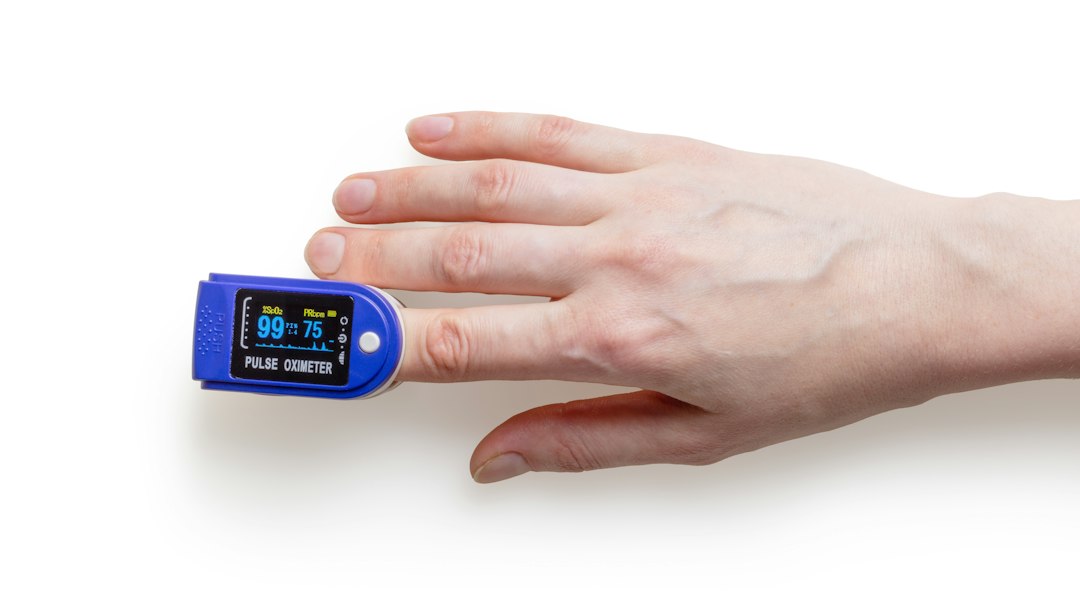
For many healthy adults at sea level, oxygen saturation is commonly in the mid-to-high 90s, but a single SpO₂ number should never be interpreted without symptoms, baseline health and measurement quality. Persistently low readings, a sudden drop from your usual level or low oxygen associated with breathlessness, confusion, blue/grey coloration, collapse or rapid deterioration needs medical assessment.
What does SpO₂ measure?
A pulse oximeter estimates the percentage of hemoglobin carrying oxygen in arterial blood. It is useful because it is quick and non-invasive, but it is still an estimate rather than a complete assessment of breathing or circulation.
Is 95% normal?
Many guidance pathways use 95% or higher as reassuring for otherwise healthy adults in the right clinical context. However, normal values vary. Some people with chronic respiratory disease have a lower usual baseline, while others may be seriously ill before the number falls dramatically.
When is an oxygen saturation concerning?
Context matters more than one universal cutoff. NHS England home-monitoring guidance used during COVID-19 advised further clinical assessment for persistent readings around 93–94% and urgent assessment for readings around 92% or lower, while also emphasizing the person’s usual baseline and symptoms. These figures are useful safety references, not a universal diagnosis rule for every condition.
Why can a pulse oximeter be wrong?
Readings may be affected by movement, cold hands, poor circulation, nail products, device quality and how the sensor is positioned. Pulse oximetry also has recognized limitations across different skin pigmentation, so symptoms and trends should not be ignored simply because the displayed number appears acceptable.
What matters more: the number or the trend?
Both matter. A person whose SpO₂ is steadily falling from their normal value may need assessment even before reaching a textbook threshold. Clinicians also look at respiratory rate, work of breathing, mental status, heart rate, skin signs and the overall trajectory.
Seek urgent help if low oxygen is accompanied by
- severe or rapidly worsening shortness of breath;
- inability to speak comfortably because of breathlessness;
- collapse or fainting;
- new confusion or marked drowsiness;
- blue or grey lips/skin;
- chest pain or other signs of serious illness.
How to get a more reliable reading
- rest the hand and keep it warm;
- remove obvious barriers such as heavy nail products when practical;
- wait for a stable pulse signal;
- repeat the reading if it does not match how the person looks;
- compare with the person’s usual baseline when known.
Why SpO₂ can look normal in a sick patient
Pulse oximetry measures oxygen saturation, not ventilation, work of breathing or tissue perfusion. A patient can be tiring, retaining carbon dioxide or developing serious illness while SpO₂ is still relatively preserved. Clinical appearance, respiratory rate, mental status and trajectory matter just as much.
When trends matter more than thresholds
A falling saturation over time can be more informative than one isolated number. Repeated measurements are particularly useful when combined with respiratory rate, heart rate, symptoms and response to treatment. Clinicians should interpret the trend rather than chase a single reading.
Special situations
Chronic lung disease, altitude, pregnancy, poor peripheral circulation and device limitations can all change how a reading should be interpreted. People with individualized target ranges should follow the plan provided by their clinician.
What pulse oximetry actually measures
Pulse oximeters estimate the percentage of hemoglobin carrying oxygen in pulsatile arterial blood. They do not directly measure oxygen delivery to tissues, carbon dioxide, respiratory effort or ventilation. This is why a person can have a normal-looking SpO₂ and still be in significant respiratory distress.
What is a typical oxygen saturation?
Many healthy adults at sea level have saturations in the mid-to-high 90s. However, baseline varies with chronic lung disease, altitude and individual factors. A single universal cutoff should not be used for every person.
Trend and symptoms are more important than one number.
How pulse oximeters can be wrong
Movement, poor circulation, cold fingers, nail products, sensor position and device quality can all affect accuracy. Some devices perform less reliably at very low saturations. If the reading does not fit the clinical picture, repeat the measurement and assess signal quality.
Skin pigmentation and device limitations
Research has shown that pulse oximetry can sometimes overestimate oxygen saturation in people with darker skin, particularly at lower values. This reinforces the need to interpret the number with symptoms and not rely on one device reading when the patient appears unwell.
SpO₂ is not ventilation
A person can retain carbon dioxide while SpO₂ remains normal, especially when receiving supplemental oxygen. Drowsiness, slow breathing, poor chest movement or exhaustion should never be dismissed because saturation looks acceptable.
When low oxygen saturation becomes concerning
Persistently low saturation, especially with breathlessness, chest pain, confusion, cyanosis or rapid deterioration, needs medical assessment. Exact action thresholds depend on the person’s baseline, underlying disease, altitude and clinical setting.
Chronic lung disease and individual targets
Some people with chronic respiratory disease have prescribed oxygen targets that differ from those of healthy adults. Follow the person’s care plan and professional guidance rather than applying a generic target.
Altitude
Oxygen saturation can be lower at altitude because atmospheric oxygen pressure is reduced. A value that is unusual at sea level may be expected at elevation. Symptoms and local guidance still matter.
COVID, pneumonia and respiratory infections
Respiratory infections can reduce oxygenation, but SpO₂ should be interpreted with work of breathing, respiratory rate, chest pain, hydration and mental status. A falling trend is important even if the absolute number has not crossed a familiar threshold.
When the number and patient disagree
If the patient is blue, confused or severely breathless but the device reads 98%, reassess the sensor and the patient. If the person looks well but the device reads 82%, repeat with a warm, still finger and a reliable device while seeking help if the low value persists.
Field scenario: normal saturation, severe breathing effort
A patient with asthma has SpO₂ 96% but is speaking only in short phrases and using accessory muscles. The normal saturation does not make the attack mild. Work of breathing and fatigue may signal serious risk.
Field scenario: low reading with cold hands
An older person has cold fingers and a reading of 86% but appears comfortable. Warming the hand and repeating the measurement gives 94%. The first reading may have been affected by poor peripheral perfusion. The patient still needs assessment in context, but technical error matters.
Common mistakes
- treating SpO₂ as a complete respiratory assessment
- ignoring respiratory rate and work of breathing
- using one cutoff for every patient
- trusting a poor-quality signal
- forgetting altitude and chronic lung disease
- assuming normal SpO₂ excludes serious illness
Key points
- Pulse oximetry estimates oxygen saturation, not ventilation.
- Technical and physiological factors can distort readings.
- Baseline, altitude and chronic lung disease affect interpretation.
- Trend and symptoms matter more than one isolated value.
- Never let a normal reading override obvious respiratory distress.
FAQ
Can a pulse oximeter be inaccurate? Yes. Motion, cold extremities, poor perfusion and device quality can affect the reading.
Should symptoms be ignored if SpO₂ looks normal? No. Severe breathlessness, confusion, cyanosis or collapse still requires urgent assessment.
Understanding oxygen saturation beyond a single number
Oxygen saturation is not the same as oxygen delivery
Pulse oximetry estimates the percentage of haemoglobin binding sites occupied by oxygen in pulsatile arterial blood. It does not directly measure how much haemoglobin is present, how well blood circulates to tissues, or how much oxygen cells can use. Oxygen delivery depends on several factors, including oxygen content and cardiac output. A person with severe anaemia may have a relatively normal saturation while carrying less total oxygen in the blood. A person with impaired circulation may have a concerning clinical picture despite a reassuring number. These distinctions matter because the question “Is the oxygen saturation low?” is narrower than “Is this person receiving enough oxygen?” Neither question can be answered from a fingertip reading alone.
Why the number must be interpreted in context
Many healthy adults at sea level have saturations in the upper 90s, but a single universal threshold is not appropriate for every patient. Baseline values may differ with altitude, chronic lung disease, congenital heart conditions and other circumstances. Device accuracy also varies, especially when readings are unexpectedly low or inconsistent with symptoms. Ask what is usual for the person, what symptoms have changed and whether a clinician has provided an individual monitoring plan. Severe breathlessness, confusion, chest symptoms, collapse or a marked change in appearance requires urgent assessment even if the display looks reassuring. The reading supports a decision; it must not make the decision on its own.
What the device is actually sensing
A conventional pulse oximeter shines light through or reflects light from tissue and analyses changes associated with pulsatile blood flow. The displayed SpO₂ is an estimate derived from optical signals and device algorithms, not a direct laboratory measurement. The pulse rate shown beside the saturation may be useful, but it should be compared with the patient’s observed pulse and the quality of the signal. If the sensor is poorly positioned or the circulation is weak, the algorithm may struggle. Some monitors show a waveform or signal-quality indicator; these help users judge whether a number is likely to be meaningful, but they do not independently validate the patient’s clinical condition.
The common sources of measurement error
Cold fingers, poor peripheral perfusion, movement, nail coatings, skin characteristics, ambient light and incorrect sensor placement can all influence readings. Different models have different performance characteristics. The US Food and Drug Administration has highlighted concerns about accuracy across skin pigmentation, including a risk that some devices may overestimate oxygen saturation in people with darker skin. This is a safety issue, not a reason to abandon pulse oximetry. It means the clinician or home user should take symptoms seriously, check measurement conditions and avoid excessive confidence in a borderline result. A good clinical assessment must remain possible when the monitor is unavailable or unreliable.
How to repeat a suspicious reading responsibly
When the situation is not immediately dangerous, check that the sensor fits correctly, the finger is reasonably warm, the person is still and the device has had time to stabilise. Consider an alternative appropriate site or another device if trained and equipped. Compare the displayed pulse with the patient’s pulse when possible, and look for signal-quality warnings. Record whether the reading changed after improving the measurement conditions. Do not keep repeating the test while severe symptoms worsen. A low reading that persists, a rapidly falling trend or a number inconsistent with the patient’s appearance warrants clinical advice. The appropriate next step depends on the overall condition and local guidance.
Breathing effort and ventilation are separate questions
A pulse oximeter does not directly measure carbon dioxide or the amount of air a patient moves. Someone may be breathing too slowly or inadequately while their saturation remains temporarily acceptable, particularly when receiving supplemental oxygen. Conversely, rapid breathing can occur for reasons that do not initially lower SpO₂. Observe respiratory rate, depth, effort, speech, fatigue and alertness. In EMS, capnography and other monitoring may add information when indicated and available, but their use depends on training and protocol. A normal SpO₂ must never be used to dismiss abnormal breathing, progressive drowsiness or a clinician’s concern about ventilation.
Carbon monoxide and other unusual limitations
Standard two-wavelength pulse oximetry may show a misleadingly reassuring saturation in carbon monoxide exposure because it cannot reliably distinguish certain haemoglobin species. If there is a plausible exposure, such as a faulty heater or an enclosed combustion source, the clinical and environmental history matters far more than a normal fingertip display. Seek emergency help and follow the relevant hazardous-scene safety guidance; do not enter an unsafe environment. Other abnormal haemoglobin states can also affect interpretation and require specialised testing. These are examples of why the technology has boundaries. They are not reasons for home users to attempt self-diagnosis with a pulse oximeter.
The difference between a snapshot and a trend
One reading tells you what the monitor estimated at one moment. Several readings, recorded with times and consistent measurement conditions, can show whether the estimate is stable, improving or deteriorating. Trends can still mislead if the sensor position, device, movement or oxygen support changes. Note those circumstances alongside the values. In a patient who is visibly struggling to breathe, deterioration in speech or alertness is meaningful even when the saturation has barely changed. In a patient with chronic disease, a departure from the usual baseline may be more informative than a generic internet chart. Clinical interpretation should combine both objective observations and the patient’s reported symptoms.
Scenario: normal saturation with serious breathing difficulty
An adult reports sudden breathlessness and chest discomfort. The pulse oximeter shows a value that many people would consider normal, but the patient is breathing rapidly, appears distressed and cannot finish a sentence. The correct response is not to reassure the patient solely because the number is high. The sudden symptoms and work of breathing require urgent assessment. For an EMS team, document the onset, associated symptoms, respiratory effort, vital-sign trends and any authorised interventions. For a member of the public, severe or rapidly worsening breathing difficulty is a reason to call local emergency services. This scenario does not establish the cause of the symptoms.
Scenario: a low value on a cold hand
A person who feels otherwise well checks a fingertip device outdoors on a cold day and sees a surprisingly low value. The finger is cold and the pulse signal is unstable. When safe, warming the hand and obtaining a stable signal may produce a different reading. That does not prove the first value was false or the second was accurate. Symptoms, medical history and repeated measurements still matter. If the person is unwell, has persistent concerning readings or develops breathing difficulty, they should seek medical advice rather than experimenting with the device indefinitely. For EMS learners, the lesson is to document signal quality and avoid treating a technical artefact as a diagnosis.
Scenario: supplemental oxygen and increasing drowsiness
A patient receiving supplemental oxygen appears to have an acceptable displayed saturation but becomes progressively harder to wake and breathes more shallowly. The reading does not establish that ventilation is adequate. The team should reassess airway and breathing, review the overall clinical picture, request appropriate support and use additional monitoring if authorised and available. Oxygen therapy decisions depend on the underlying condition and local protocol; this example is not a universal instruction to increase or decrease oxygen. The teaching point is that saturation and ventilation are different physiological concepts. A patient can deteriorate while the pulse oximeter temporarily looks reassuring.
Children and the importance of observable behaviour
Pulse oximetry in children must be interpreted with age, clinical appearance, activity and sensor suitability in mind. Movement and an incorrectly sized probe can make readings unreliable. A child who is struggling to breathe, becoming unusually sleepy, making grunting noises or showing a significant change in colour or responsiveness needs urgent assessment, regardless of the displayed value. Parents and caregivers often notice meaningful changes in feeding, interaction and breathing before a device shows a clear trend. Paediatric thresholds and oxygen strategies are condition- and system-specific. Follow the child’s care plan where applicable and seek professional help rather than relying on adult internet thresholds.
Chronic respiratory disease and personalised targets
Some people with chronic respiratory disease have an individual oxygen plan developed by their clinical team. Their expected values, monitoring instructions and prescribed oxygen targets may differ from those used for other patients. That does not make new severe symptoms harmless. Ask whether there is a documented baseline, whether the patient uses oxygen at home and what has changed from usual function. In professional practice, oxygen administration and target ranges should follow the patient’s condition and the local clinical guideline. Members of the public should not alter prescribed oxygen settings on the basis of a generic article without appropriate medical advice. The key distinction is between a known stable baseline and a new or worsening problem.
Altitude, exertion and the limits of comparison
Oxygen saturation can change with altitude, exertion and environmental conditions. A value measured at sea level should not be compared mechanically with a value at high altitude without considering acclimatisation, symptoms and the individual’s baseline. Exercise may reveal limitations that are not evident at rest, but home users should not deliberately provoke symptoms to test themselves. When an unexpectedly low reading occurs, the safest interpretation is to combine the value with how the person feels and the quality of the measurement. Persistent or unexplained abnormalities warrant professional assessment. Severe symptoms require urgent help regardless of where the reading was obtained.
Handover: report the reading and its reliability
A useful EMS handover includes the SpO₂ value, time, whether the patient was breathing room air or receiving oxygen, and relevant changes in breathing and circulation. Mention movement, poor perfusion or an unstable signal if they may have affected the result. Include the respiratory rate, work of breathing, speech, alertness and other relevant observations rather than repeating the number alone. Distinguish a measured value from a clinical interpretation. For example, “SpO₂ displayed 94% on room air with a stable signal, respiratory rate elevated and increasing effort” is more useful than “oxygen low.” Do not invent certainty when the monitor was unreliable or when the context changed during observation.
Questions people commonly ask about SpO₂
Can a normal SpO₂ rule out pneumonia, a clot or heart disease? No; the reading does not identify or exclude those conditions. Is one low number always an emergency? Not necessarily, because measurement errors and individual baselines matter, but concerning symptoms or persistent abnormalities need assessment. Can a pulse oximeter tell whether carbon dioxide is high? No. Can dark skin affect accuracy? Some devices have documented performance differences across pigmentation; interpret the number with clinical context. Is a smartwatch reading equivalent to a medical assessment? No. Should I wait for a number to fall before seeking help for severe breathlessness? No. When should I call emergency services? Severe difficulty breathing, collapse, sudden confusion or other major warning signs require urgent help.
Trusted sources: US FDA: Pulse Oximeters; NHS: Shortness of breath; Resuscitation Council UK: ABCDE approach. These sources provide general safety principles; local care pathways differ.
Continue reading: shortness of breath warning signs, leg swelling and breathlessness, ABCDE assessment, fever and red flags, and the Health Questions hub.