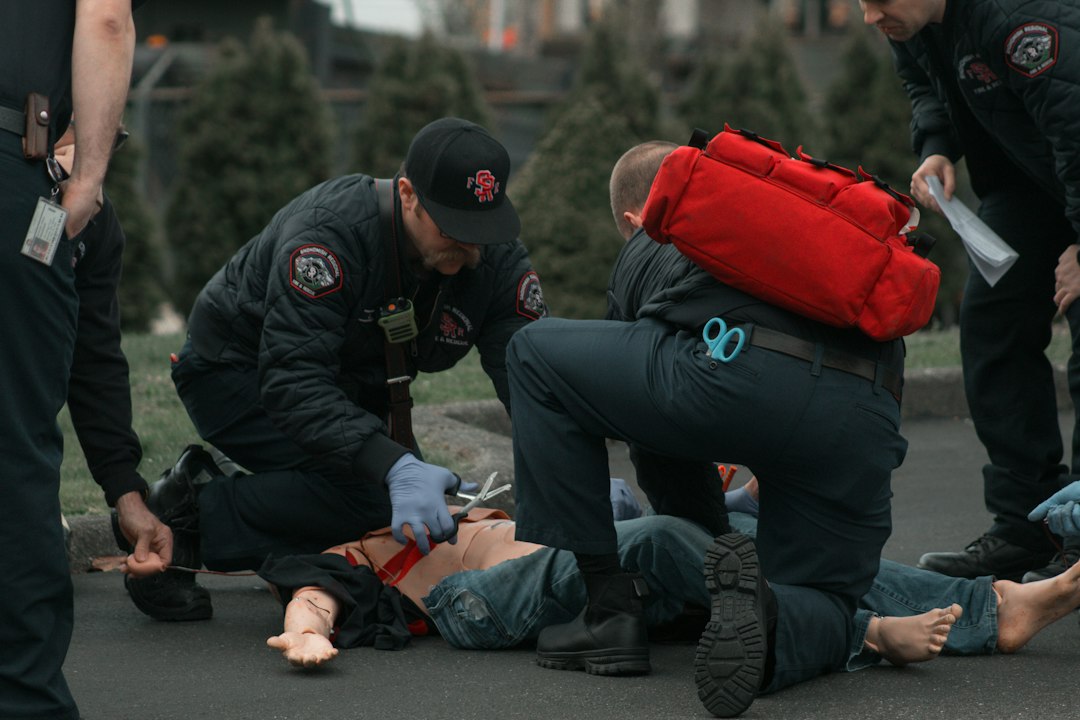
ABCDE Assessment: A Practical Guide for EMS and Paramedics
The ABCDE approach is a structured method for identifying and treating immediate life threats in priority order: Airway, Breathing, Circulation, Disability and Exposure. The central rule is simple: find life-threatening problems early, act within your scope, reassess the effect of what you did and call for additional help when needed.
A — Airway
Ask whether the airway is open and whether the patient can maintain it. Listen for abnormal airway sounds, assess speech and look for obstruction, secretions, swelling or trauma. A threatened airway takes priority over moving on to the next letter.
B — Breathing
Assess respiratory rate, work of breathing, chest movement, breath sounds where appropriate, oxygen saturation and the overall effectiveness of ventilation. Do not let a normal SpO₂ distract from obvious respiratory distress. Oxygenation and ventilation are related but not identical.
C — Circulation
Look for catastrophic bleeding first when relevant. Assess pulse, blood pressure, skin signs, capillary refill where useful, peripheral perfusion and signs of shock. Think about trends rather than isolated numbers.
D — Disability
Perform a rapid neurological assessment. This may include AVPU or GCS, pupils, blood glucose and any obvious focal neurological deficit depending on context and protocol. A change in mental status is a clinical finding, not a diagnosis.
E — Exposure / Environment
Expose enough of the patient to find important injuries, rashes, bleeding or other clues while protecting privacy and preventing heat loss. Environment matters: cold, heat, toxins, scene hazards and mechanism can all influence the assessment.
ABCDE is not a one-time checklist
The Resuscitation Council UK emphasizes completing the initial assessment, treating life-threatening problems before moving on, assessing response to treatment and reassessing regularly. A patient can worsen after an initially reassuring assessment, so ABCDE should be repeated after interventions, movement or a change in condition.
What makes an ABCDE assessment strong?
- prioritizing immediate threats rather than collecting every detail first;
- using the whole team effectively;
- recognizing deterioration early;
- reassessing after interventions;
- communicating findings in a structured way;
- knowing when to escalate.
Common mistakes
- jumping to a diagnosis before completing the primary assessment;
- focusing on the monitor before looking at the patient;
- moving on despite an unresolved airway or breathing problem;
- failing to repeat vital signs;
- giving a handover full of numbers without explaining what changed.
How to use ABCDE in real practice
ABCDE works best as a dynamic cycle. Identify the first life threat, intervene within your scope, reassess immediately, then continue. If the patient deteriorates, return to A rather than continuing mechanically through the sequence.
What to communicate at each stage
- A: airway patency, voice, obstruction and airway risk.
- B: respiratory rate, work of breathing, chest movement, oxygenation and ventilation clues.
- C: bleeding, pulse, blood pressure trend, skin signs and perfusion.
- D: mental status, glucose, pupils and focal deficits.
- E: injuries, rash, temperature, environment and mechanism.
Reassessment after intervention
Every intervention should answer a question: did the patient improve? After airway positioning, oxygen, hemorrhage control, analgesia, fluids or movement, repeat the relevant observations and document the response. The reassessment is part of the intervention, not an optional extra.
ABCDE in trauma versus medical emergencies
The framework stays the same, but priorities may change. In major trauma, catastrophic external hemorrhage may be addressed before or alongside airway assessment. In medical emergencies, airway and breathing problems may dominate early. Local protocols should guide any modified sequence.
FAQ
Do you finish the entire ABCDE before treating? No. Treat immediate threats as you find them.
When should ABCDE be repeated? After interventions, movement, deterioration, handover delays or any meaningful change in condition.
Why ABCDE works under pressure
ABCDE is valuable because it creates a shared priority order when the scene is complex. It prevents the team from being distracted by a dramatic but non-life-threatening problem while airway failure, respiratory compromise or shock goes untreated. The framework also makes delegation easier because team members can communicate where they are in the assessment and what threat has been identified.
The sequence is not rigid. Many trauma systems address catastrophic external hemorrhage before airway. The principle is always the same: treat the most immediate reversible threat first.
Scene information before A
Before touching the patient, assess safety, mechanism, number of patients, hazards and need for additional resources. A structurally unsafe scene, violence, fire, chemicals or traffic risk can change the entire plan.
First impression also matters. Position, color, speech, breathing pattern and interaction can provide valuable clues before formal examination begins.
A — Airway: assess patency and future risk
Airway assessment asks two questions: is the airway open now, and is it likely to remain open? A patient with facial burns, swelling or progressive reduced consciousness may have a patent airway that is becoming threatened.
Listen for stridor, gurgling, snoring or silence. Look for blood, vomit, secretions, swelling and trauma. Assess whether the patient can speak normally and handle secretions. Any intervention should be followed by immediate reassessment.
B — Breathing: oxygenation is not enough
Breathing assessment includes rate, depth, pattern, work, chest movement and air entry where appropriate. SpO₂ is helpful but can be misleading if interpreted alone. A patient can be tiring or retaining carbon dioxide while saturation remains acceptable.
Look for asymmetry, accessory muscle use, inability to speak, cyanosis, paradoxical movement and signs of exhaustion. Reassess after oxygen, bronchodilator therapy, ventilation support or positioning.
C — Circulation: find bleeding and assess perfusion
Catastrophic external hemorrhage should be controlled rapidly. Then assess pulse, skin, capillary refill where useful, blood pressure and mental status. Remember that blood pressure can remain preserved during compensation.
Think about the cause of circulatory compromise: bleeding, sepsis, anaphylaxis, dysrhythmia, pump failure or obstruction. The circulation step identifies instability; further assessment helps determine why.
D — Disability: rapid neurological risk assessment
Use AVPU or GCS, pupils, glucose and focused neurological findings as appropriate. New confusion or reduced consciousness is a clinical emergency even if other vital signs are not dramatic.
Look for stroke signs, seizure activity and evidence of head injury. Treat immediately reversible causes within scope and continue reassessment.
E — Exposure: look for what the clothes and environment hide
Expose enough to identify significant bleeding, rash, burns, trauma or medical clues. Preserve dignity and prevent hypothermia. In trauma, heat loss can worsen coagulopathy; in medical emergencies, rash or device sites may reveal infection or anaphylaxis.
The environment itself can provide diagnostic information, including medications, toxins, heaters, syringes or evidence of prolonged immobility.
ABCDE in respiratory distress
A patient with severe dyspnea may have a patent airway but life-threatening B problems. Do not let a normal oxygen saturation delay recognition of fatigue or poor ventilation. Reassess respiratory rate, effort and mental status after every intervention.
ABCDE in shock
A patient with shock may initially appear to have an airway and breathing problem because tachypnea is prominent. Continue the sequence and assess perfusion. Cool skin, altered mental status, weak pulses and a falling pressure trend may reveal the circulatory problem.
ABCDE in trauma
Major trauma can require catastrophic hemorrhage control before or alongside airway management. Cervical-spine considerations, mechanism and hidden bleeding influence priorities. Reassessment after movement or extrication is essential because the patient can deteriorate rapidly.
ABCDE in altered mental status
Do not start at D simply because the complaint is neurological. Hypoxia, airway obstruction and shock can all cause confusion. A structured A-to-E approach reduces the risk of missing a reversible physiological cause.
Teamwork and task allocation
ABCDE becomes more efficient when one clinician maintains the overall sequence while others perform delegated tasks. One team member may obtain vitals, another prepare oxygen, another gather history. Closed-loop communication helps confirm that actions were completed and reassessed.
The team leader should periodically summarize: “Airway clear, breathing improving after treatment, circulation stable, now checking glucose and neuro.”
Reassessment after every intervention
Every treatment should have an expected effect. Airway positioning should improve airflow; hemorrhage control should stop bleeding; oxygen or ventilation support should improve oxygenation or work of breathing; medication should produce a measurable clinical response.
If the expected improvement does not occur, reassess the problem and widen the differential. A treatment that fails is information.
When to stop and go back
Return to A whenever the patient deteriorates, after significant movement or if a new life threat appears. Do not continue mechanically through the letters while the patient worsens. The sequence is a loop.
Documentation and handover
ABCDE provides a natural structure for handover. Report the main abnormalities, what you did and the response. Avoid reciting every normal finding if it adds no value. “Airway patent; severe wheeze with RR 32 improved after treatment; circulation stable; GCS 15; no rash” is concise and clinically useful.
Field scenario: distracting injury
A patient has an obvious open leg fracture and is screaming in pain. The dramatic injury attracts attention, but the patient is also pale, tachypneic and hypotensive. ABCDE prevents fixation on the leg and redirects attention to circulation and possible hidden hemorrhage.
Field scenario: normal monitor, sick patient
A patient with severe sepsis has acceptable SpO₂ and systolic pressure but is confused, tachypneic and mottled. ABCDE keeps the clinician focused on overall physiology instead of one reassuring monitor value.
Common advanced mistakes
- treating ABCDE as documentation rather than active prioritization
- moving on before checking whether an intervention worked
- allowing a monitor to replace direct examination
- failing to restart the sequence after deterioration
- collecting detailed history before controlling a life threat
- forgetting environmental and exposure clues
Key points
- ABCDE is a prioritization system, not a checklist race.
- Treat threats as they are found.
- Reassess after every intervention.
- Restart the sequence whenever the patient deteriorates.
- Use the structure to improve teamwork and handover.
- Follow local protocol where catastrophic hemorrhage or other priorities modify the sequence.
Source
Resuscitation Council UK — The ABCDE Approach