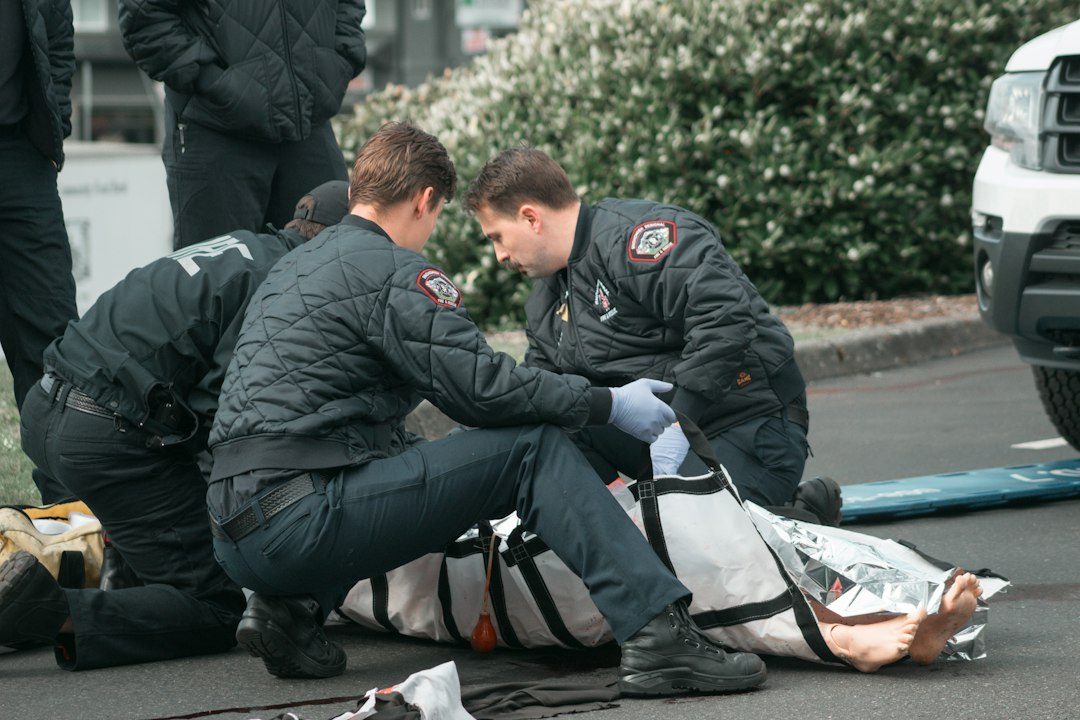
The primary survey identifies and treats immediate life threats; the secondary survey gathers a more complete history, examination and set of findings once immediate threats are being managed.
Confusing the two can delay care. A detailed history is valuable, but not while an airway is obstructed, breathing is failing or catastrophic bleeding is uncontrolled.
What belongs in the primary survey?
ABCDE is a common structure: Airway, Breathing, Circulation, Disability and Exposure. In major trauma, catastrophic hemorrhage may be addressed before or alongside airway depending on the protocol.
What belongs in the secondary survey?
The secondary survey may include SAMPLE, OPQRST, head-to-toe examination, focused system examination, repeated vital signs and review of medications or records.
When do you move on?
You move from primary to secondary assessment when immediate life threats have been identified and addressed as far as possible. Unstable patients may require repeated primary surveys.
Why reassessment bridges both phases
Assessment is not linear. After oxygen, airway positioning, hemorrhage control, medication, movement or deterioration, return to the relevant ABCDE step.
Medical versus trauma patients
The structure is flexible. A medical patient may need a focused secondary exam; trauma may need a systematic head-to-toe survey. The priority remains identifying what can kill the patient first.
Common mistakes
- taking a full history before treating an airway problem
- assuming one normal set of vitals ends the primary survey
- failing to repeat the primary survey after movement
- performing a complete head-to-toe exam when a focused assessment is more appropriate
Why the distinction matters
The difference between primary and secondary survey is not simply “quick exam versus detailed exam.” It is a difference in purpose. The primary survey asks: what can kill this patient now, and what must be addressed immediately? The secondary survey asks: what additional information will clarify the problem, reveal hidden injury or illness, and improve treatment, transport and handover?
When those purposes are confused, clinicians can spend valuable time collecting history while a life threat remains unresolved, or they can stop after a rapid primary assessment and miss important secondary findings.
The primary survey is a cycle, not a doorway
ABCDE is commonly used to structure the primary survey, but the sequence is dynamic. If you identify a life threat at B, intervene and reassess B before moving on. If the patient deteriorates while you are at D, return to A. The goal is not to “finish” the primary survey; it is to keep the most dangerous problem at the top of the priority list.
Scene safety, catastrophic hemorrhage and the need for immediate resources may modify the exact sequence according to local protocol. The underlying principle remains prioritization of threats that are rapidly reversible or immediately fatal.
Airway during the primary survey
Assess whether the patient can maintain and protect the airway. Speech can provide rapid information: a patient who speaks clearly has airflow, but that does not guarantee the airway will remain safe. Listen for stridor, gurgling, snoring or silence. Look for facial trauma, swelling, vomit, blood or foreign material.
After any airway intervention, reassess immediately. Improvement must be demonstrated, not assumed.
Breathing during the primary survey
Assess respiratory rate, effort, chest movement, air entry where appropriate, oxygen saturation and signs of fatigue. The purpose is to recognize failure, not to complete a full respiratory examination. Severe bronchospasm, pneumothorax, pulmonary edema and hypoventilation require prompt recognition and action within scope.
A detailed history of the patient’s asthma can wait if they are barely moving air.
Circulation during the primary survey
Look for catastrophic bleeding, pulse abnormalities, poor perfusion and hemodynamic instability. Blood pressure is useful but may lag behind deterioration. Skin signs, mental status and pulse quality can reveal circulatory compromise before profound hypotension appears.
In trauma, hemorrhage control can take priority alongside airway assessment depending on the system’s protocol. In medical cases, circulatory instability may stem from arrhythmia, sepsis, anaphylaxis, cardiogenic shock or many other causes.
Disability and immediate neurological threats
Rapid neurological assessment may include AVPU or GCS, pupils, glucose and obvious focal deficits. The aim is to identify a dangerous change in consciousness or neurological function, not to complete a full neurological examination.
Hypoglycemia, hypoxia, stroke, seizure, intoxication and head injury can all affect mental status. Correct immediately reversible causes within scope while continuing the assessment.
Exposure and environment
Expose enough to identify serious injury, rash, bleeding or environmental clues, while preserving dignity and preventing heat loss. The scene itself can be diagnostic: medication packets, heaters, chemicals, drug paraphernalia, damaged vehicles or empty alcohol containers may provide context.
When the secondary survey begins
The secondary survey begins when immediate life threats are being controlled and the patient is stable enough for more detailed assessment. It may include SAMPLE, OPQRST, a focused physical examination, a head-to-toe trauma exam, medication review, records, family history, repeated vitals and targeted tests.
The exact depth depends on acuity and transport time. An unstable patient may have only an abbreviated secondary survey because ongoing resuscitation and transport take priority.
Focused versus head-to-toe secondary assessment
Not every patient needs the same secondary exam. A stable patient with isolated ankle trauma may require a focused musculoskeletal assessment rather than a complete medical review. A high-energy trauma patient may require a systematic head-to-toe examination. A patient with abdominal pain needs a different focused examination from a patient with syncope.
Structure should improve care, not create unnecessary ritual.
History belongs in the secondary survey—but timing is flexible
SAMPLE and OPQRST are often taught as secondary-survey tools, but real practice is flexible. While one team member manages airway or circulation, another may obtain essential history from family. The important rule is that history gathering must not delay treatment of an immediate threat.
Some history is itself urgent. Anticoagulant use after head trauma, time last known well in stroke, allergen exposure in anaphylaxis or pregnancy status in abdominal pain can immediately change priorities.
Reassessment connects the two surveys
The patient can move backward in the sequence at any time. After medication, movement, extrication, analgesia, oxygen, fluids or a change in symptoms, repeat the relevant primary-survey elements. A secondary survey does not mean the primary survey is “finished forever.”
This is especially important during transport, when deterioration can be subtle and the environment encourages task fixation.
Medical patient example
A patient with chest pain is pale and diaphoretic. The primary survey identifies a patent airway, increased respiratory rate and borderline blood pressure. Immediate monitoring, ECG and protocol-directed care take priority. Once the patient is stabilized, OPQRST, SAMPLE and a focused cardiovascular examination add detail.
Trauma example
A motorcyclist has severe leg bleeding and altered mental status. Catastrophic hemorrhage control and ABC priorities come before asking about allergies or last meal. Once immediate threats are being addressed, the secondary survey searches systematically for additional injuries that may have been masked by the obvious leg trauma.
Pediatric example
In a child, the primary survey emphasizes appearance, work of breathing and circulation because children can compensate before rapidly decompensating. The secondary survey may rely heavily on caregiver history, age-appropriate behavior and a focused examination.
Common sequencing errors
- taking a complete history while a life threat remains untreated
- performing a detailed head-to-toe exam on an unstable patient before transport priorities are addressed
- failing to return to the primary survey after an intervention
- assuming “normal vital signs” mean the primary survey is complete
- collecting irrelevant secondary details that do not change care
- forgetting hidden injuries because one dramatic injury dominates attention
Handover should reflect both surveys
A clear handover separates immediate threats and what was done from the additional findings that explain the case. Start with the chief problem and primary-survey abnormalities, then give the important history, focused examination, trends and response to treatment.
This mirrors how receiving clinicians think and helps them understand both severity and context.
Deciding what matters first when information is incomplete
Real prehospital assessment begins before anyone has established a diagnosis. Dispatch information may be incomplete, a patient may describe several symptoms at once, and the environment can change the order in which tasks are possible. The distinction between primary and secondary survey is useful precisely because it separates two questions: what threatens life or function immediately, and what additional information will help explain the presentation? This separation does not mean a clinician ignores the history during the first minute. It means that information gathering must never displace a necessary response to an immediate threat.
Start with scene safety and an overall impression. Is the patient interacting normally? Is breathing visibly laboured? Is there uncontrolled bleeding, an unsafe mechanism of injury, a hazardous atmosphere, or a need for extra resources? A team can delegate brief history questions while another member assesses breathing and circulation. The order of tasks may be adapted for major haemorrhage, entrapment, a paediatric patient, or a deteriorating medical patient. What must remain constant is recognition, escalation and repeated assessment.
How to decide whether the secondary survey can safely begin
A secondary survey becomes useful once immediate problems have been identified and addressed as far as the team’s competence and equipment allow. It is not necessary to achieve perfect physiology before asking further questions, but it is unsafe to become absorbed in a complete history while the patient is losing consciousness or struggling to breathe. Consider the stability of the airway, adequacy of breathing, evidence of perfusion, neurological state, and whether a new problem is emerging. Record uncertainties explicitly rather than interpreting a temporarily normal monitor display as reassurance.
Some patients remain unstable throughout the encounter. In those cases, the secondary survey may consist of a few targeted questions and observations collected during movement or transport. A patient with sudden severe headache and a new neurological deficit, for example, may need an abbreviated focused history that establishes the time last known well, rather than a prolonged examination of unrelated systems. A severely injured patient may need rapid identification of additional bleeding or injuries while definitive assessment continues at the receiving facility.
A practical decision table
| Situation | Immediate priority | Useful next information |
|---|---|---|
| Patient cannot maintain a clear airway | Airway assessment, authorised support, urgent escalation | Relevant cause and history only when safe |
| Severe respiratory distress | Breathing assessment, permitted interventions, repeat observations | Onset, triggers, relevant medication and prior episodes |
| Major external haemorrhage | Control bleeding within scope and seek resources | Mechanism, other injuries, anticoagulant use |
| New confusion with abnormal observations | Reassess ABCDE and investigate reversible threats within scope | Baseline cognition, onset, medication, glucose where authorised |
| Stable patient with isolated limb pain | Confirm no immediate threat and assess injury | Focused history, examination, neurovascular findings, function |
This table illustrates priorities, not a universal algorithm. Regional guidelines determine permitted assessments, treatment and destination decisions. An EMT, a UK ambulance clinician and an Australian paramedic may work under different legal frameworks despite using similar assessment language.
Reassessment triggers: when to return to ABCDE
Returning to the primary survey is particularly important after a change in posture, lifting, extrication, a procedure, medication, new symptom or change in level of consciousness. An apparently comfortable patient may become breathless when lying flat; a patient who was speaking clearly may develop swelling or fatigue; and bleeding can become apparent after clothing is moved. Reassessment should compare the current findings with the initial picture and state what changed.
Look for trends across several domains rather than treating each number separately. A rising respiratory rate, increasing effort and shorter sentences together may signal deterioration even if oxygen saturation remains unchanged. A new change in mental status, skin perfusion or pulse quality may matter before a dramatic blood-pressure change appears. Document the time of each observation and the circumstances in which it was obtained. A value measured during agitation is not interchangeable with a resting value taken ten minutes later.
After an intervention
Reassessment asks whether the intervention achieved the intended clinical effect and whether new problems appeared. If a position change was intended to ease breathing, record the patient’s comfort, respiratory effort and objective observations. If an authorised intervention was performed, document the time, indication, response and any adverse effect. A statement such as “treatment given, patient stable” conceals the clinical trajectory; a sequence of observations allows the receiving team to understand what happened.
Focused secondary surveys for different presentations
Medical illness
For medical presentations, a focused examination may be more informative than a routine head-to-toe survey. In breathlessness, the chronology, associated chest symptoms, fever, medication and functional baseline can help frame possible causes without establishing a diagnosis. In abdominal pain, the pattern of pain, vomiting, bleeding, pregnancy possibility when relevant and signs of poor perfusion may be important. In altered mental status, a witness account of baseline function and the exact time of change may be crucial.
Trauma
In trauma, secondary assessment looks for injuries that were not obvious during the initial life-threat assessment. The mechanism can guide attention, but it cannot prove or exclude injury. Inspect and palpate only as clinically appropriate and within training, while maintaining patient dignity and avoiding unnecessary movement. Assess circulation, sensation and movement distal to a limb injury where authorised; note deformity, tenderness, bleeding and changes over time. A dramatic visible wound must not distract from less obvious threats elsewhere.
Children and older adults
Children may compensate physiologically before suddenly deteriorating, and their normal observations differ by age. Observe interaction, work of breathing, skin appearance and caregiver concerns. Use age-appropriate methods and escalate according to local paediatric guidance. In older adults, medication, frailty, baseline cognitive impairment and atypical symptoms may complicate the picture. A seemingly minor fall may involve anticoagulant use or an illness that caused the fall. Ask what is different from the patient’s usual state.
Field scenario: a stable-looking patient who changes during transport
An adult reports dizziness after standing and initially answers questions clearly. The crew completes an initial primary survey and begins a focused history. During transfer to the stretcher, the patient becomes pale and less responsive. At this point, continuing a detailed medication inventory would be a mistake. The team should return to airway, breathing, circulation and neurological assessment, repeat available observations, and escalate according to its protocols. Once immediate priorities are addressed, the history can resume if clinically useful.
The handover should distinguish the first assessment from the deterioration: initial complaint, initial observations, the change during movement, reassessment findings, interventions within scope and the response. This sequence communicates more than a single label such as “syncope” or “hypotension”, which may not adequately describe the event or establish its cause.
Field scenario: a painful ankle after a road collision
A patient is sitting beside a damaged vehicle and points to an obviously painful ankle. It would be tempting to start with a detailed ankle examination. Instead, scene safety, mechanism, overall appearance, airway, breathing, circulation and neurological state come first. Once immediate threats are excluded or addressed, the team can examine the ankle and other relevant regions, assess distal function within scope, and ask about the collision, medications and previous conditions. New chest pain or confusion would prompt a return to the primary survey.
Team communication and structured handover
A useful division of work is to have one team member lead the primary survey while another obtains observations, prepares equipment or collects brief witness information. The team should verbalise significant changes and avoid assumptions that someone else has already checked a finding. Closed-loop communication matters when urgent help is requested: identify who will make the call, what information must be relayed and whether the request was acknowledged.
In handover, start with the main concern and immediate threats, then give important secondary findings, the timeline, interventions and response. Frameworks such as SBAR or local equivalents can improve clarity, but a framework does not replace accurate clinical facts. Separate direct observations from the patient’s account and from bystander statements. Include what could not be assessed, such as an examination limited by pain, poor access or patient refusal.
Country and scope differences
The ABCDE principles are widely taught, but authorised actions are not identical internationally. In the United States, state licensing, service medical direction and local protocols shape the EMT or paramedic role. In the United Kingdom, professional registration, employer policy and role-specific competencies matter. Canadian regulation varies by province, while Australia and New Zealand have their own registration and clinical-governance arrangements. Never interpret a description of assessment as permission to perform an invasive intervention, administer a medication or choose a destination outside local authority.
For learners, the safest approach is to master the reasoning sequence, recognise limitations, practise communicating uncertainty and consult the current local clinical practice guidelines. International comparisons can illuminate principles but should not be copied into a protocol.
Questions that often arise in practice
Is the primary survey finished once all five letters have been checked?
No. It is an ongoing cycle. The patient’s condition and the response to treatment determine when to repeat it. A change in breathing or consciousness can immediately reset priorities.
Should vital signs be collected during the primary or secondary survey?
Relevant observations may be obtained during the initial assessment and repeated during the secondary assessment and transport. The timing and completeness depend on acuity, resources and local protocols. Do not delay a time-critical intervention to finish a routine set.
Can a patient refuse a secondary examination?
Consent, capacity and refusal are governed by local law and policy. Explain the purpose of the examination, respect dignity, document the discussion and seek appropriate advice when capacity or safety is uncertain.
Further reading: Resuscitation Council UK: ABCDE approach; NICE CG50: recognising deterioration. Related guides: ABCDE assessment, SAMPLE history, vital-sign trends, patient handover, and the Paramedic Education hub.
Key points
- The primary survey finds and treats immediate threats.
- The secondary survey builds a more complete clinical picture.
- Assessment is cyclical, not linear.
- History and examination depth should match acuity.
- Reassessment after intervention is mandatory for meaningful evaluation.
- Structure should improve prioritization, not slow down urgent care.
FAQ
Is SAMPLE part of the primary survey? Usually no; it is generally part of the history once immediate threats are addressed.
Can the secondary survey be skipped? In some time-critical situations it may be abbreviated, but relevant information should still be gathered when possible.
Does primary survey mean only trauma? No. ABCDE applies broadly to medical emergencies too.
Related ActuMedic guides
Sources
Educational content for EMS learners. Follow local protocols, scope of practice and medical direction.