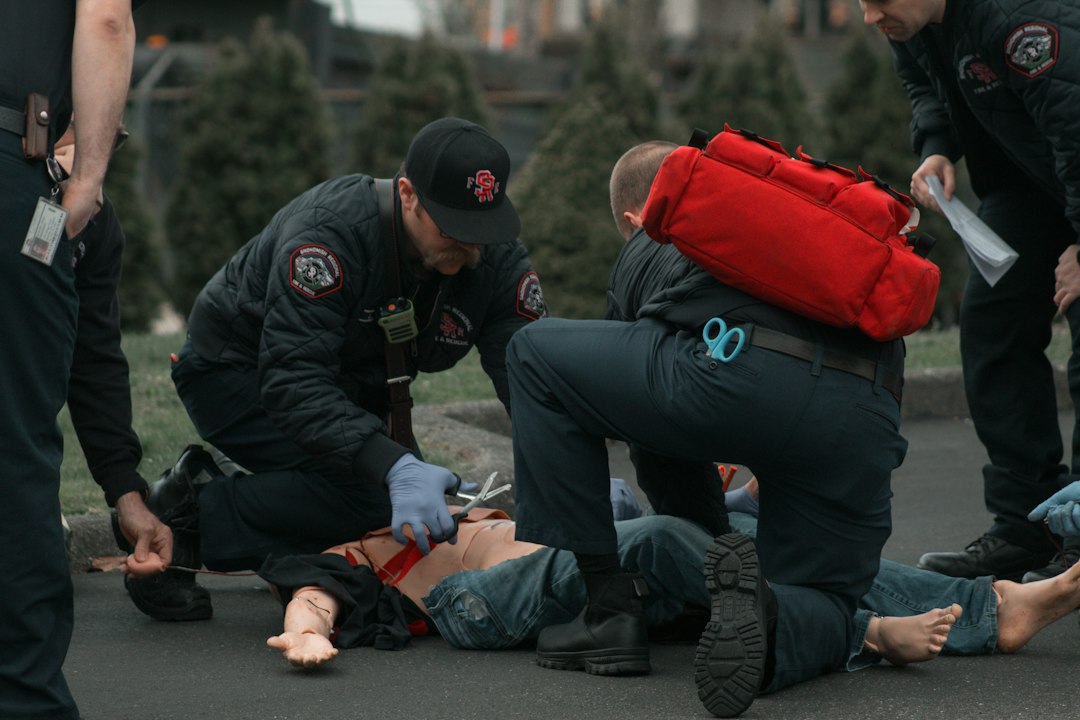
AVPU Scale: Alert, Voice, Pain, Unresponsive Explained for EMS
AVPU is a rapid consciousness scale: Alert, responds to Voice, responds to Pain, or Unresponsive.
Its strength is speed. Its limitation is that it is broad and does not describe subtle neurological change. It is best used as part of a full primary assessment and repeated over time.
A — Alert
The patient is awake and appropriately responsive. Alert does not automatically mean neurologically normal; confusion, focal deficits and abnormal behavior still matter.
V — responds to Voice
The patient is not fully alert but responds when spoken to. Note whether the response is appropriate, delayed or only brief.
P — responds to Pain
The patient responds only to a painful stimulus. Use locally approved, safe stimulus techniques and avoid unnecessary or repeated painful stimulation.
U — Unresponsive
No meaningful response to voice or pain indicates severe impairment and requires immediate ABCDE reassessment, airway consideration and escalation.
AVPU versus GCS
AVPU is faster; GCS provides more detail through eye, verbal and motor components. A patient who is not fully alert often warrants a more structured neurological assessment.
Common mistakes
- assuming Alert means normal cognition
- using inappropriate painful stimuli
- documenting AVPU without noting change over time
- focusing on the scale instead of glucose, oxygenation, trauma or other causes
What AVPU is designed to do
AVPU is a rapid responsiveness scale used during initial assessment: Alert, responds to Voice, responds to Pain, or Unresponsive. Its main strength is speed. It helps a clinician identify whether consciousness is normal, impaired or deteriorating without requiring a long neurological examination.
Its main limitation is low granularity. Two patients who are both “V” may be very different: one may briefly open their eyes to a name, another may speak but remain confused. AVPU should therefore trigger further assessment when the patient is not clearly alert.
A — Alert is not the same as normal
An alert patient is awake without needing stimulation, but that does not mean cognition is normal. Stroke, delirium, intoxication, hypoglycemia and head injury can all occur in a patient who is technically “A.” Observe orientation, behavior, speech, memory and focal neurological function.
Baseline matters. A patient with dementia may be alert but chronically disoriented, while a normally independent patient with new confusion requires investigation even though they are awake.
V — response to voice
A patient classified as V is not fully alert but responds to verbal stimulation. Note what the response actually is. Do they open their eyes, speak, follow a command, or only make a brief movement? The quality of the response matters even though AVPU records only one category.
A change from A to V is clinically significant and should prompt immediate reassessment of airway, breathing, circulation, glucose and neurological status.
P — response to pain
P indicates that meaningful response is produced only by a painful stimulus. This is a marker of significant impairment. Use safe, locally accepted stimuli and avoid unnecessary repetition. The goal is to determine responsiveness, not to inflict pain.
Whenever a patient is P, airway protection, ventilation, oxygenation, glucose and possible neurological or toxicological causes deserve urgent attention.
U — unresponsive
Unresponsive means no meaningful response to voice or pain. Treat this as a critical finding. Return immediately to ABCDE, assess airway patency and breathing effectiveness, check circulation and glucose, and escalate according to local protocol.
Do not assume the cause. Opioids, seizure, stroke, hypoglycemia, hypoxia, trauma and many other conditions can produce unresponsiveness.
AVPU and airway risk
Reduced responsiveness increases concern about airway protection, but AVPU is not an airway decision tool by itself. A patient who is V may still protect their airway well, while an alert patient with facial burns or severe swelling may have a threatened airway.
Use responsiveness as one part of the airway assessment, not as a substitute for examining the airway and breathing.
AVPU versus GCS
AVPU is faster, while the Glasgow Coma Scale provides separate eye, verbal and motor components. In many systems, AVPU is ideal for the first look and GCS adds detail once immediate threats are being managed.
There is no exact conversion between AVPU and GCS. Avoid claiming that “V equals GCS 12” or similar simplifications unless a local protocol explicitly defines one.
Causes of reduced responsiveness to consider
- hypoxia or hypercapnia
- hypoglycemia or other metabolic disturbance
- stroke or intracranial hemorrhage
- seizure and post-ictal state
- head injury
- opioids, sedatives or alcohol
- sepsis or shock
- temperature extremes
The purpose of the list is not to diagnose from AVPU. It is to remind the clinician that altered consciousness has a broad differential.
Trend is often more important than the initial category
A patient who moves from A to V during transport is deteriorating even if blood pressure and oxygen saturation remain unchanged. Conversely, improvement from P to V after correction of hypoglycemia is clinically meaningful.
Record the time of each assessment and what intervention occurred between observations.
AVPU in children
AVPU is widely used in pediatric assessment, but age-appropriate behavior matters. A sleepy infant, a frightened toddler and a teenager respond differently to strangers. Caregiver input can help determine whether the child’s responsiveness is abnormal for them.
In children, reduced interaction, poor eye contact, weak cry or abnormal response to parents may be as important as the formal category.
AVPU in older adults
Older adults may have baseline cognitive impairment, hearing loss or communication difficulties that make a verbal response appear abnormal. Establish usual function where possible before assuming that reduced responsiveness is new.
At the same time, do not dismiss new drowsiness as “just dementia.” Acute change from baseline is a red flag for illness or injury.
Field scenario: hypoglycemia
A diabetic patient is initially P, breathing spontaneously with a patent airway. Glucose is very low. After protocol-directed treatment, the patient becomes V and later A. The changing AVPU category provides a simple way to document response, but the handover should also include glucose values, treatment and the quality of recovery.
Field scenario: head injury
A patient after a fall is initially A but becomes V twenty minutes later. Even if the total vital-sign picture is otherwise stable, the change in responsiveness is important. Repeat neurological assessment, pupils and GCS, and escalate according to trauma guidance.
Common mistakes
- assuming Alert means normal neurological function
- using unsafe or repeated painful stimuli
- failing to document a change in category
- using AVPU as a diagnosis rather than a description
- ignoring hearing, language or developmental barriers
- not moving to a more detailed neurological assessment when needed
Key points
- AVPU is fast but deliberately simple.
- Alert does not equal neurologically normal.
- Voice, Pain or Unresponsive should trigger deeper assessment.
- Trend and baseline are essential.
- Use GCS or focused neurological assessment when more detail is required.
FAQ
Is AVPU a diagnostic tool? No. It describes responsiveness.
Can AVPU be used in children? It is used in pediatric assessment, but age-appropriate behavior and local pediatric guidance matter.
Should a change from A to V concern EMS? Yes. Any new decline in responsiveness deserves reassessment.
Related ActuMedic guides
Sources
Educational content for EMS learners. Follow local protocols, scope of practice and medical direction.